Teaching
Courses, materials, and interactive tools from the group
For current course offerings at Georg-August-Universität Göttingen, please visit the university page ↗.
Mathematik für Studierende der Chemie I
Interaktive Apps zur Vorlesung — kein Download, direkt im Browser.
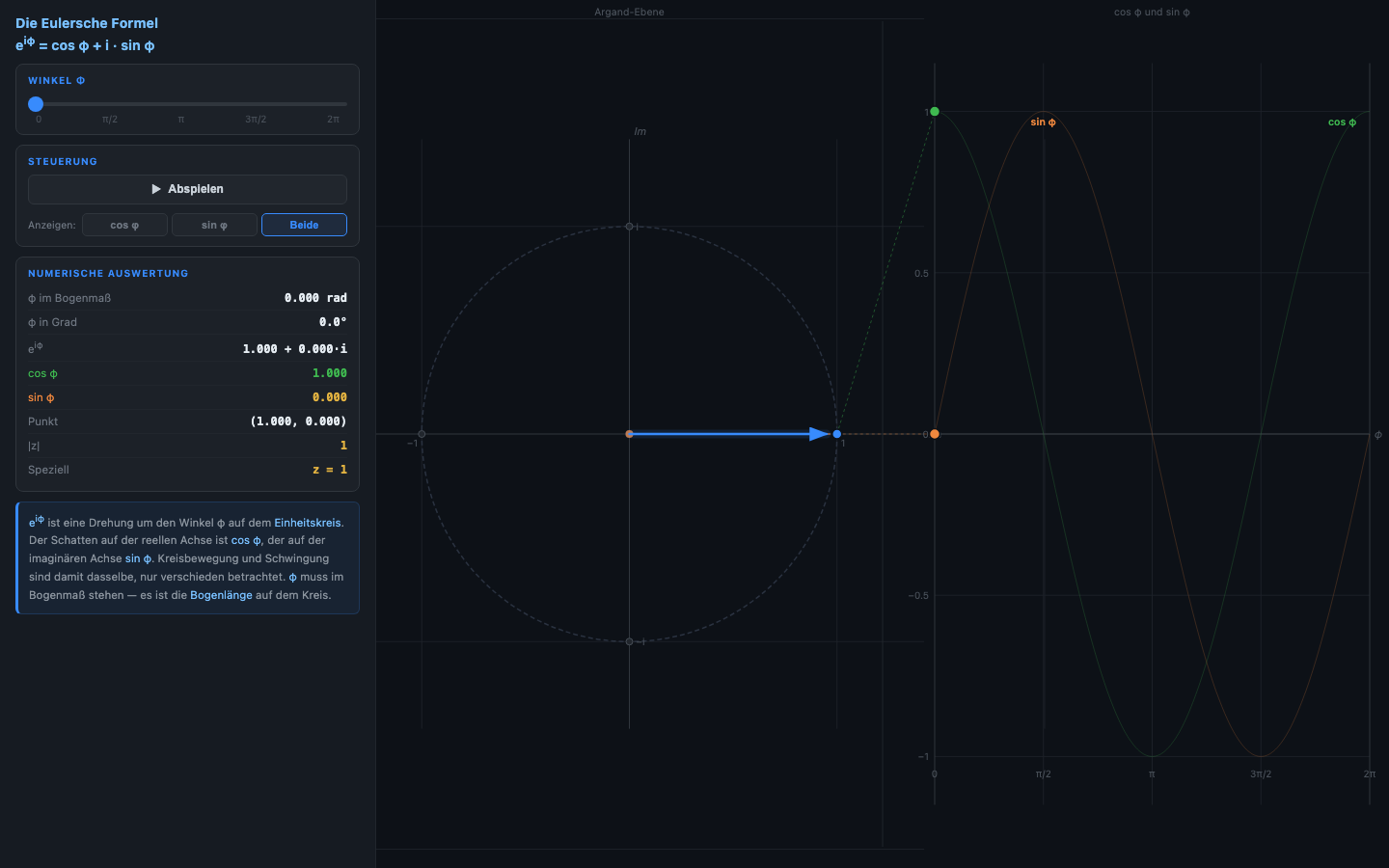
Die Eulersche Formel — eiφ = cos φ + i·sin φ
Zeigt e^(iφ) als Drehung auf dem Einheitskreis. Die Projektionen auf die reelle und imaginäre Achse erzeugen cos φ und sin φ direkt sichtbar. Interaktiver Phasor, automatischer Umlauf, Spur beider Funktionen — Euler-Identität bei φ = π hervorgehoben.
Mathematik für Studierende der Chemie II
Interaktive Apps zur Vorlesung — kein Download, direkt im Browser.
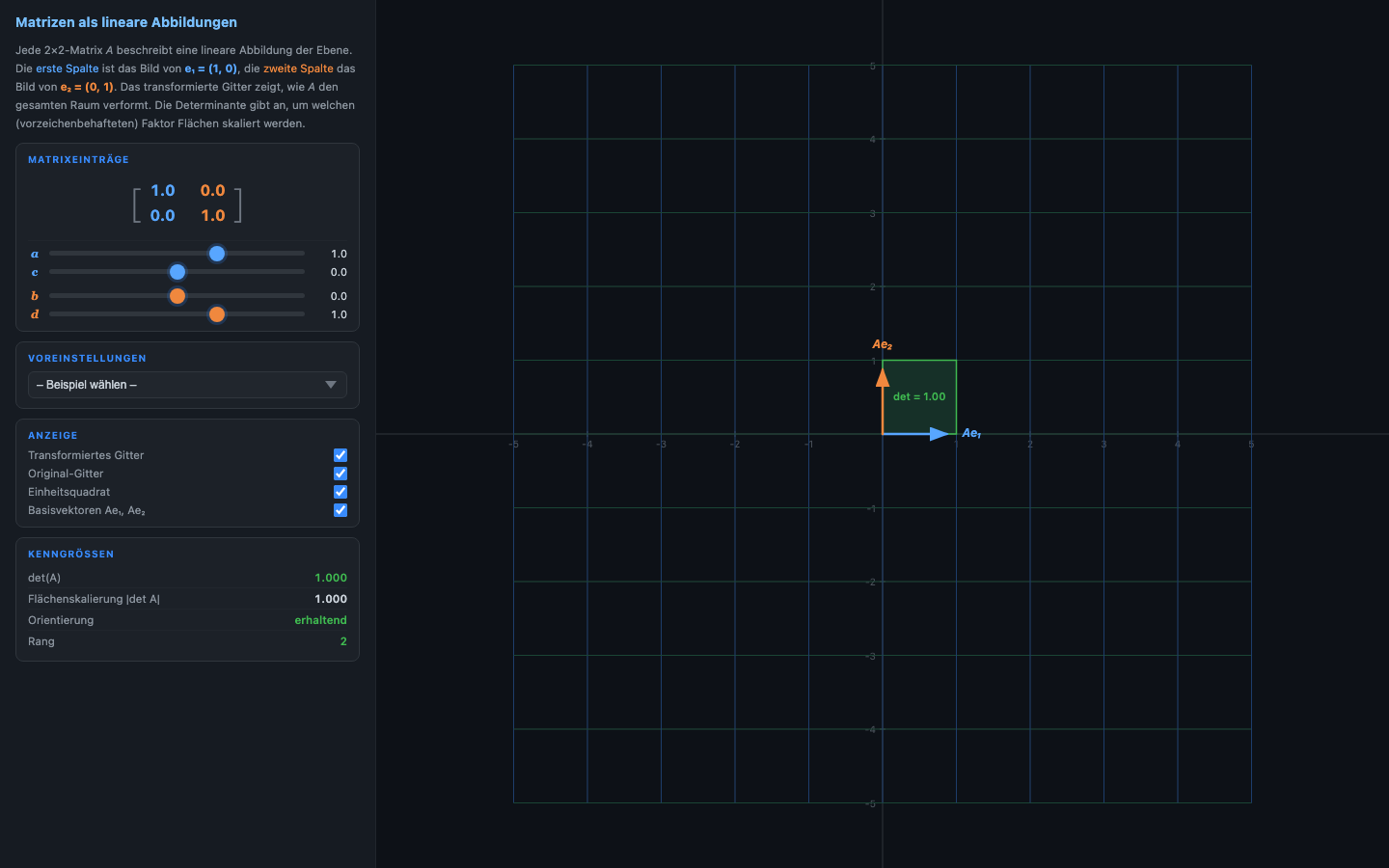
Matrizen als lineare Abbildungen
Zeigt, wie eine 2×2-Matrix den gesamten Raum verformt: Spalten als Bilder der Basisvektoren, transformiertes Gitter und Einheitsquadrat in Echtzeit. Determinante als vorzeichenbehafteter Flächenskalierungsfaktor — direkt sichtbar als Fläche des Bildparallelogramms.
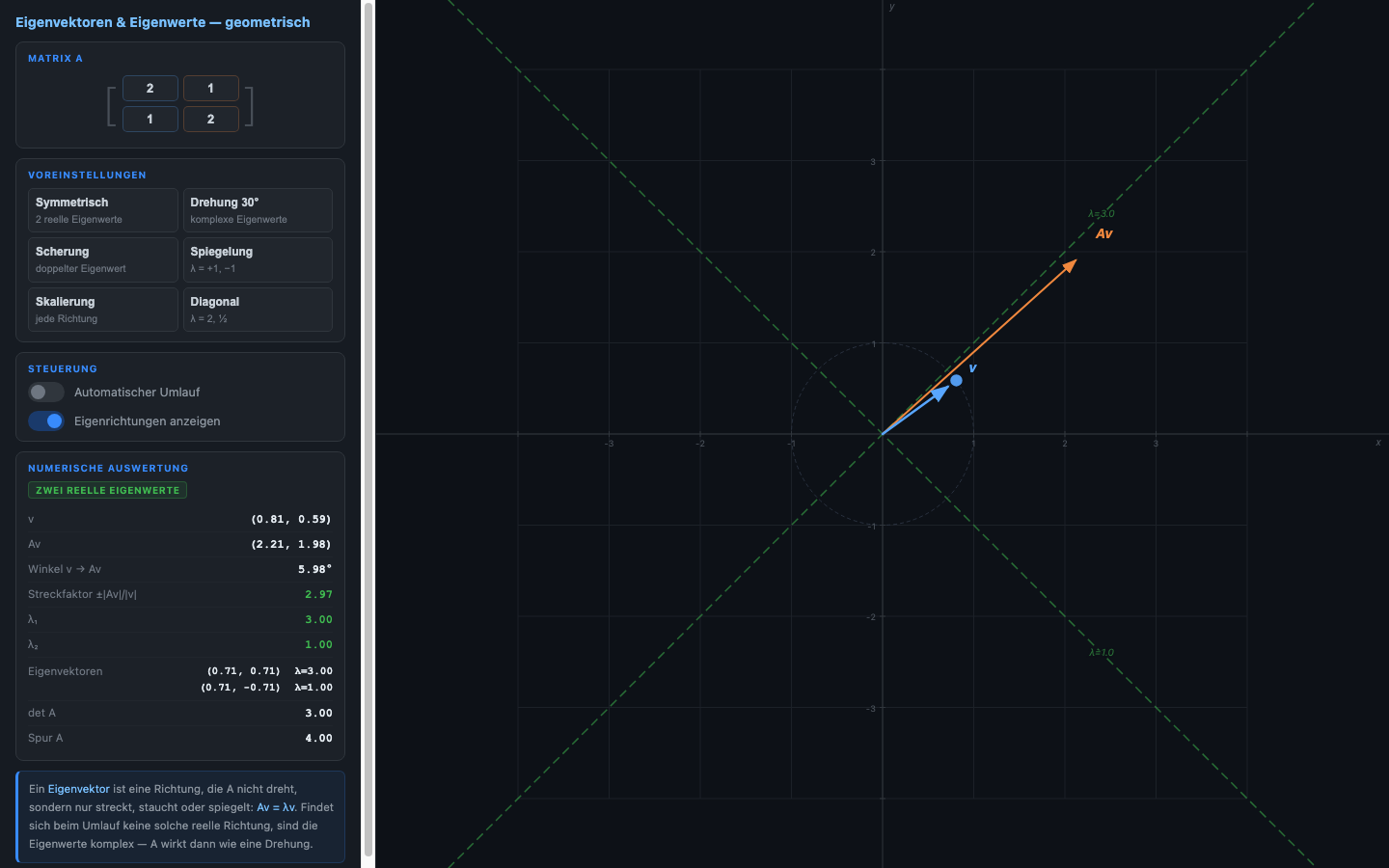
Eigenvektoren & Eigenwerte — geometrisch
Zeigt geometrisch, was ein Eigenvektor bedeutet: eine Richtung, die A nicht dreht, sondern nur streckt oder spiegelt. Vektor v auf dem Einheitskreis ziehbar; Av folgt live. Automatischer Umlauf markiert Eigenrichtungen. Sechs Voreinstellungen für reelle, komplexe und doppelte Eigenwerte.
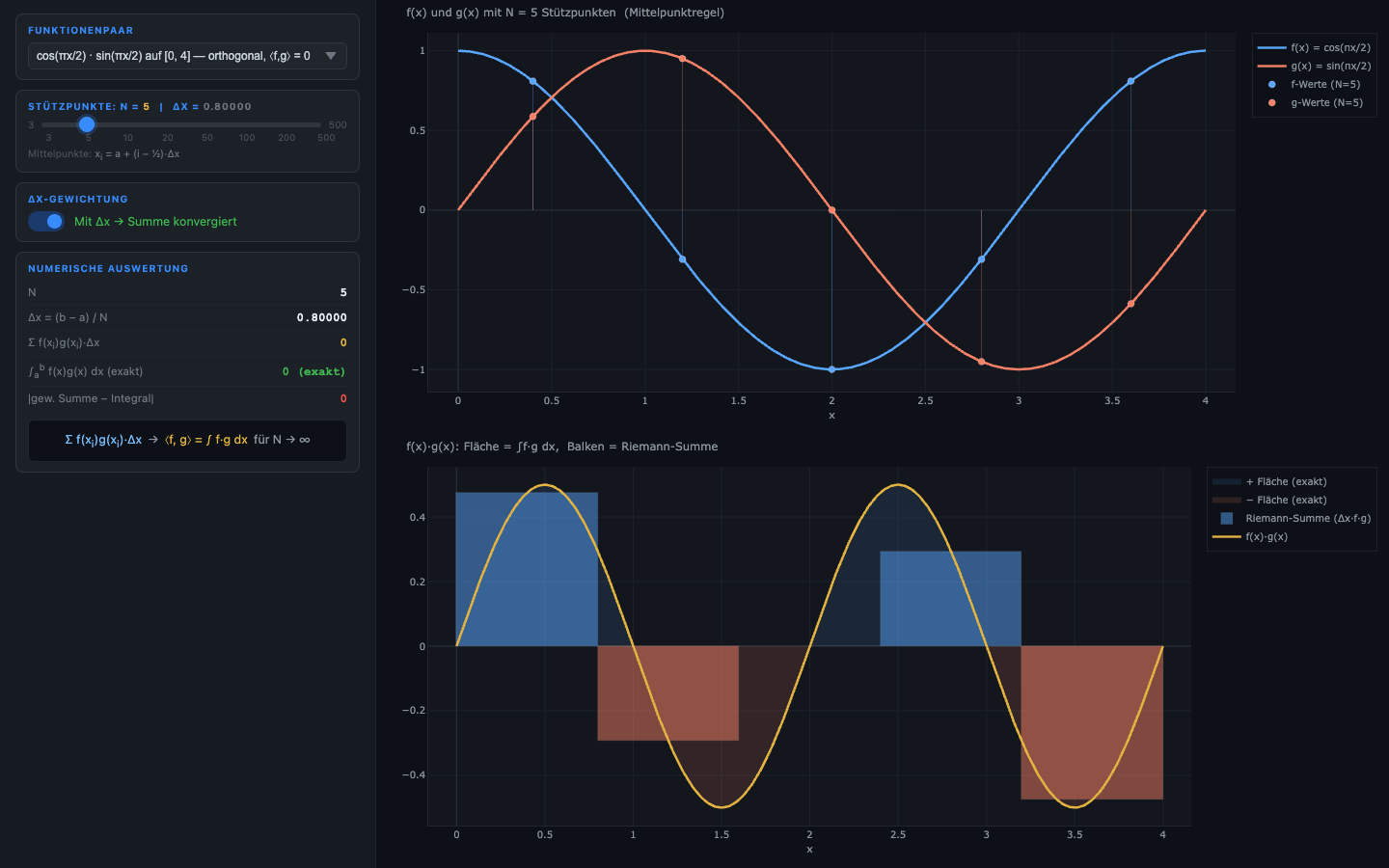
Vom Skalarprodukt zum L²-Skalarprodukt
Zeigt anschaulich, wie das endlichdimensionale Skalarprodukt über gewichtete Riemann-Summen zum L²-Skalarprodukt ⟨f, g⟩ = ∫ f·g dx wird. N und Δx-Gewichtung interaktiv einstellbar; fünf Funktionspaare zu Orthogonalität, Fourier-Moden und Domänensymmetrie.
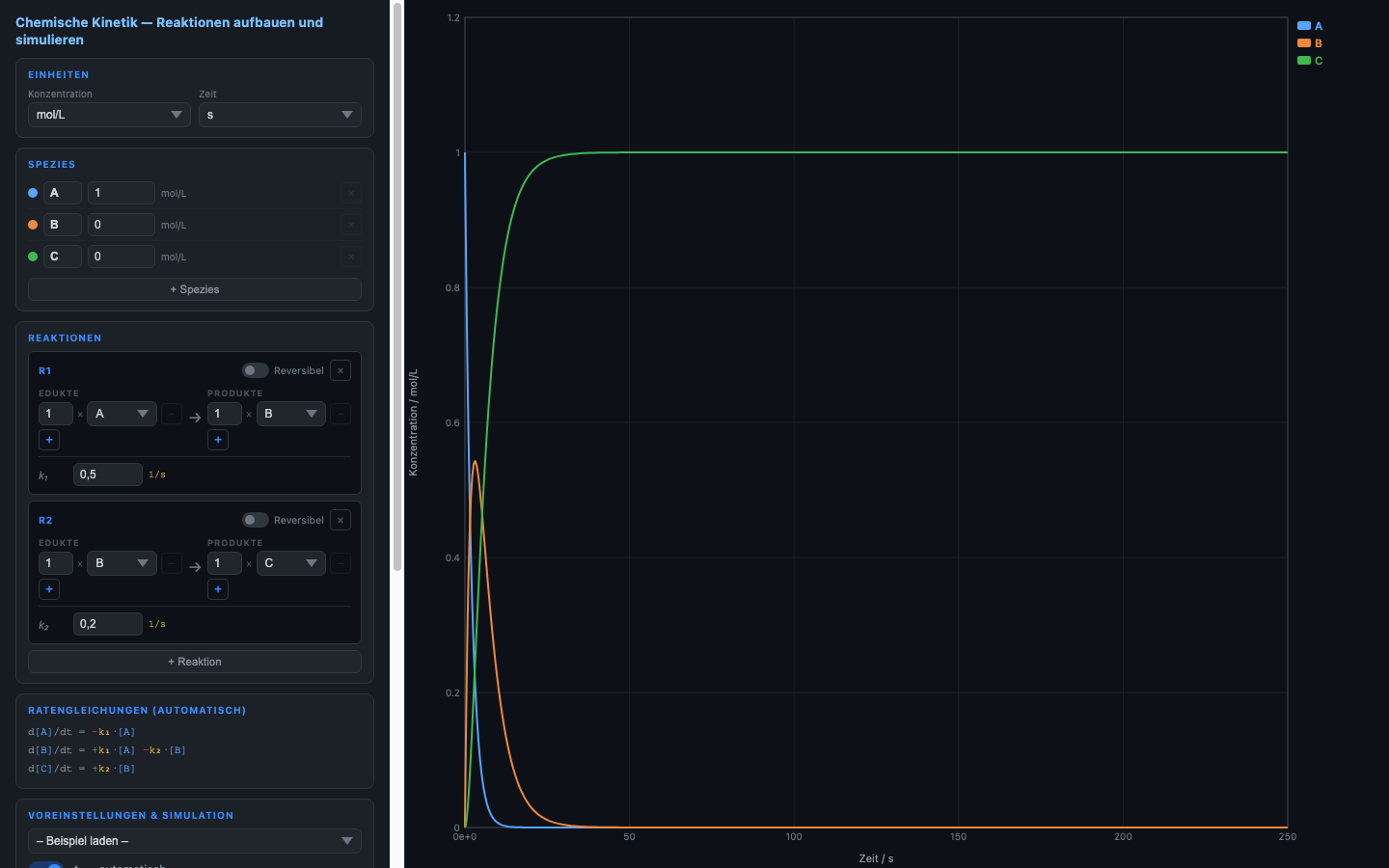
Chemische Kinetik — Reaktionen aufbauen und simulieren
Baut beliebige Reaktionsmechanismen aus bis zu 5 Spezies und 6 Schritten — reversibel oder irreversibel. Die App leitet Ratengleichungen automatisch ab, löst sie mit einem adaptiven RK45-Integrator und zeigt Konzentrations-Zeit-Kurven. Einheiten der Geschwindigkeitskonstanten werden live aus der Stöchiometrie berechnet.
Quantenchemie
Interaktive Apps zur Vorlesung — kein Download, direkt im Browser.
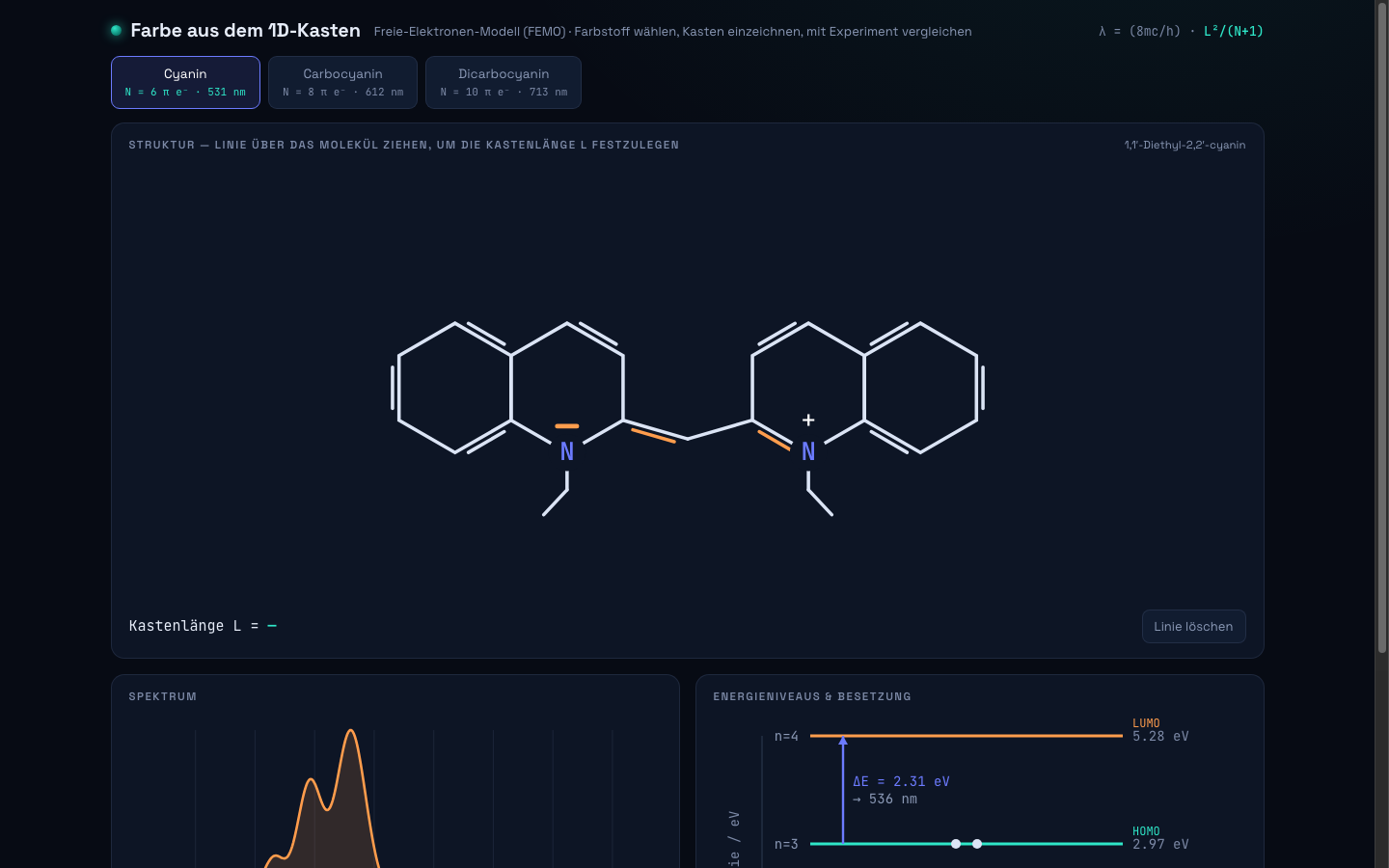
Farbe aus dem 1D-Kasten
Leitet die Absorptionswellenlänge von Cyaninfarbstoffen aus dem Teilchen-im-Kasten-Modell her. Kastenlänge L direkt auf die Molekülstruktur zeichnen — die App berechnet λTheorie und vergleicht mit dem experimentellen Spektrum inklusive Vibronikstruktur.
Nuclear quantum effects
Interactive apps — no download, straight in the browser.
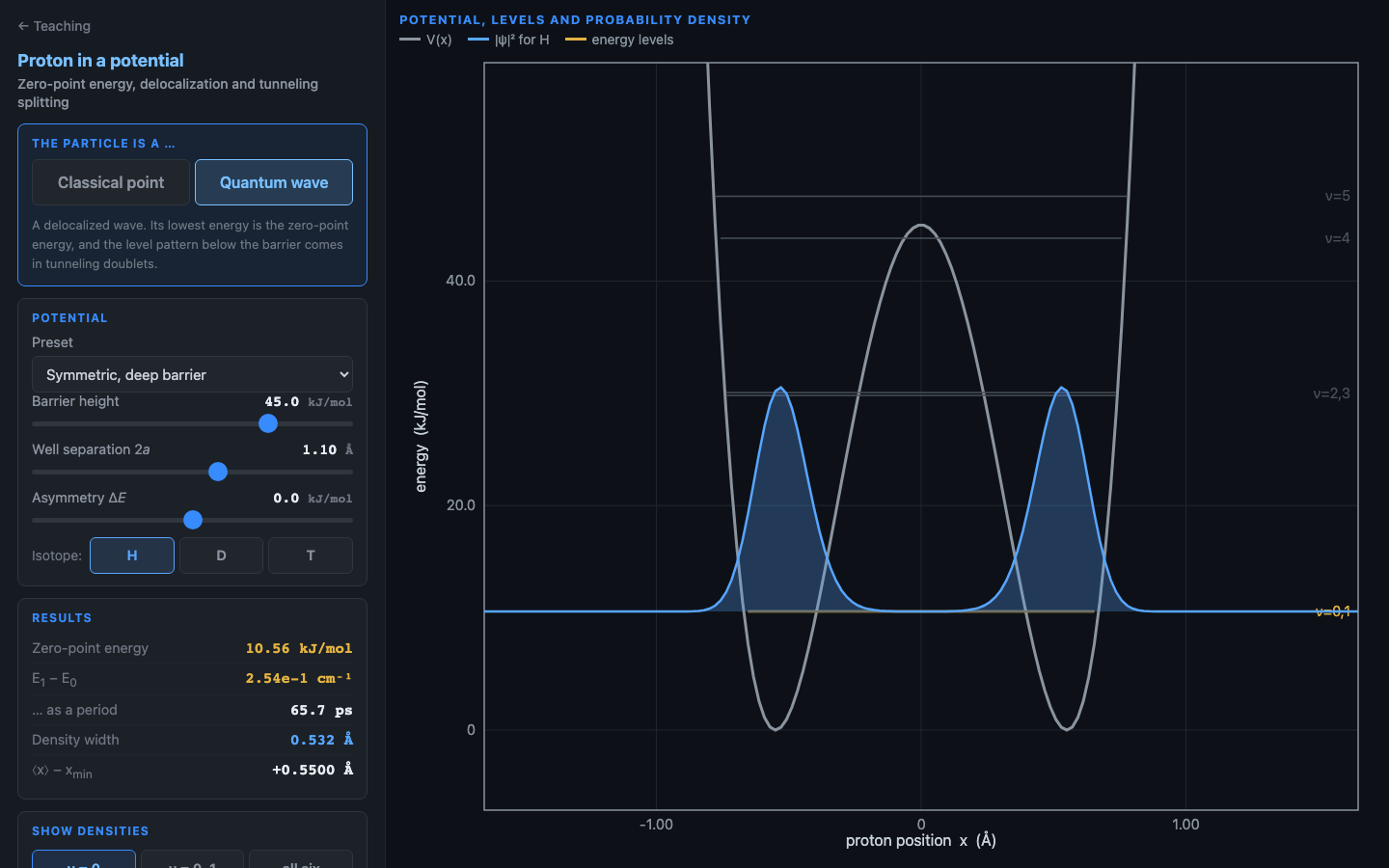
Proton in a potential
Solves the one-dimensional Schrödinger equation for a proton in a double well and draws the result on top of the potential. A single toggle switches between a classical point particle sitting at the minimum and the delocalized quantum state — the zero-point energy and the tunneling splitting E1−E0 appear as numbers in cm−1. Switching H → D → T changes the splitting by orders of magnitude.
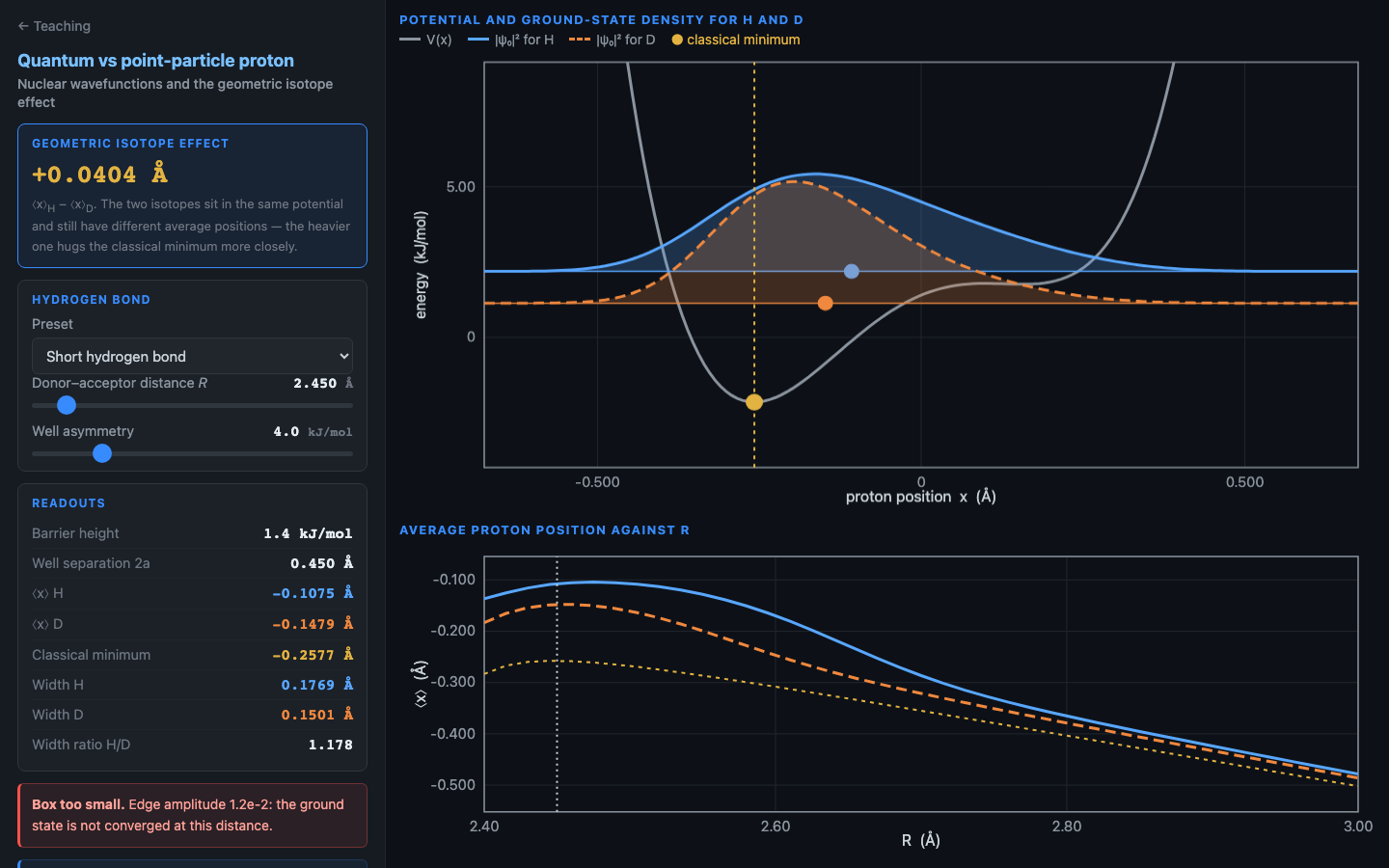
Quantum vs point-particle proton
One slider moves the donor and acceptor apart, raising the barrier and separating the wells at the same time. The ground-state densities of H and D are drawn together in the same potential: the lighter isotope is broader and sits further from the classical minimum, which is the geometric isotope effect measured directly as ⟨x⟩H − ⟨x⟩D.
Rate models compared
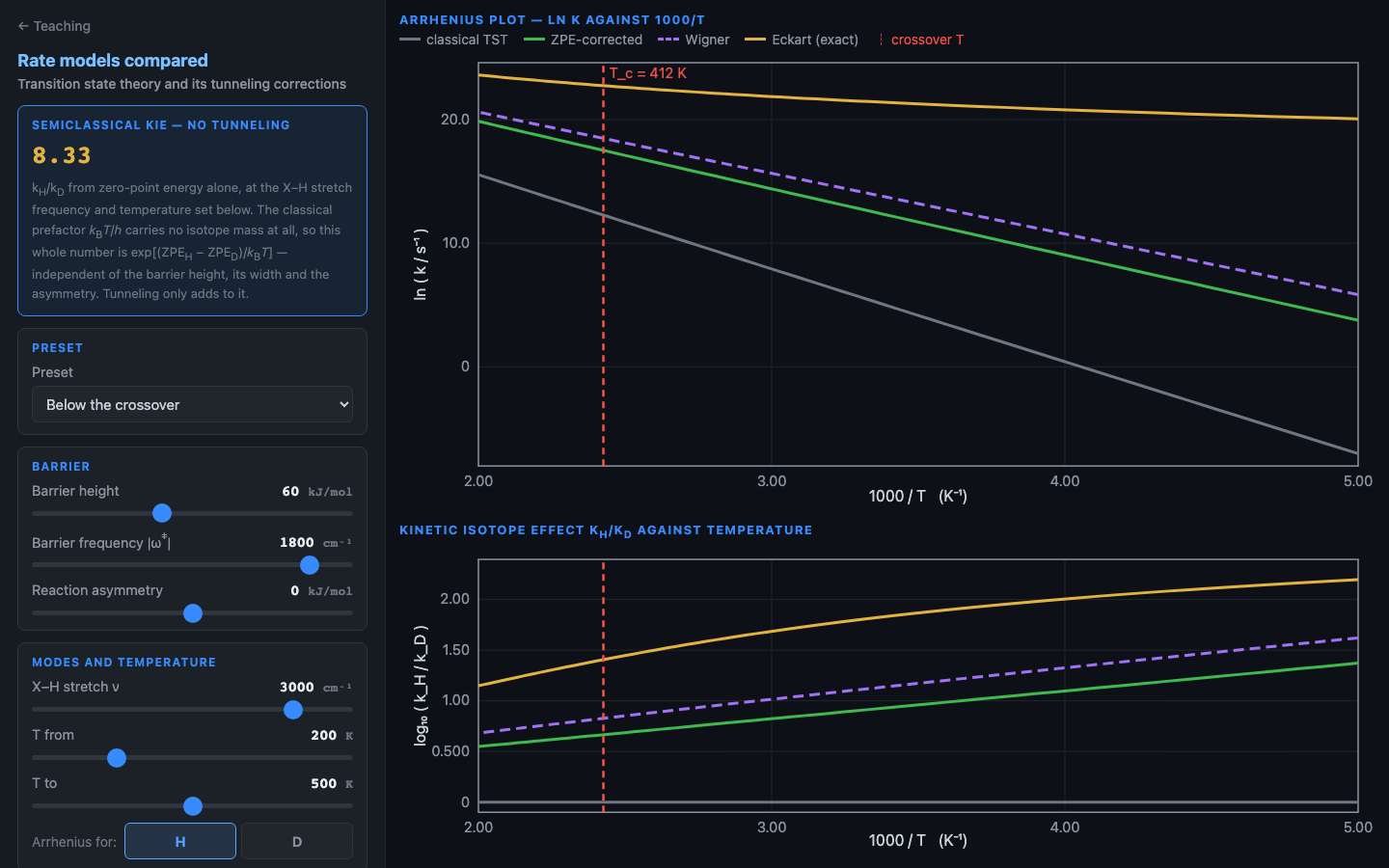
Classical transition state theory, a zero-point-energy correction, the Wigner factor and the thermally averaged Eckart transmission, all on one Arrhenius plot. Because the Eckart barrier has a closed-form transmission probability, the curve labelled exact really is exact — above the crossover temperature Wigner tracks it, below it fails by orders of magnitude.
PCET as an overlap problem
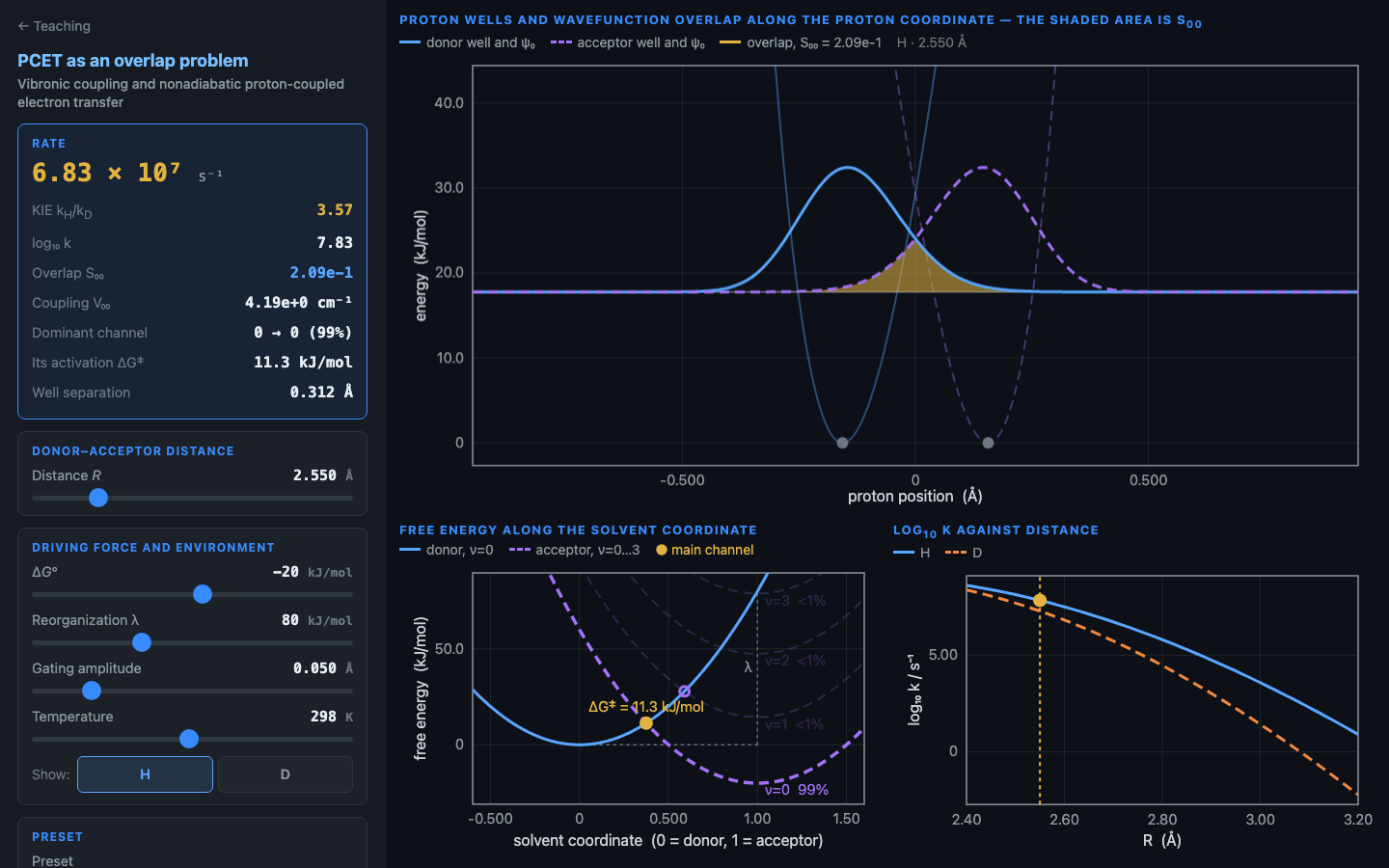
Proton-coupled electron transfer in the nonadiabatic limit, where the rate is carried entirely by the overlap of the proton wavefunctions on donor and acceptor. Pulling the two apart by a few tenths of an Ångström thins the shaded overlap to nothing and drops the rate by orders of magnitude; conformational gating brings it back and collapses the isotope effect.
Model prediction vs measurement
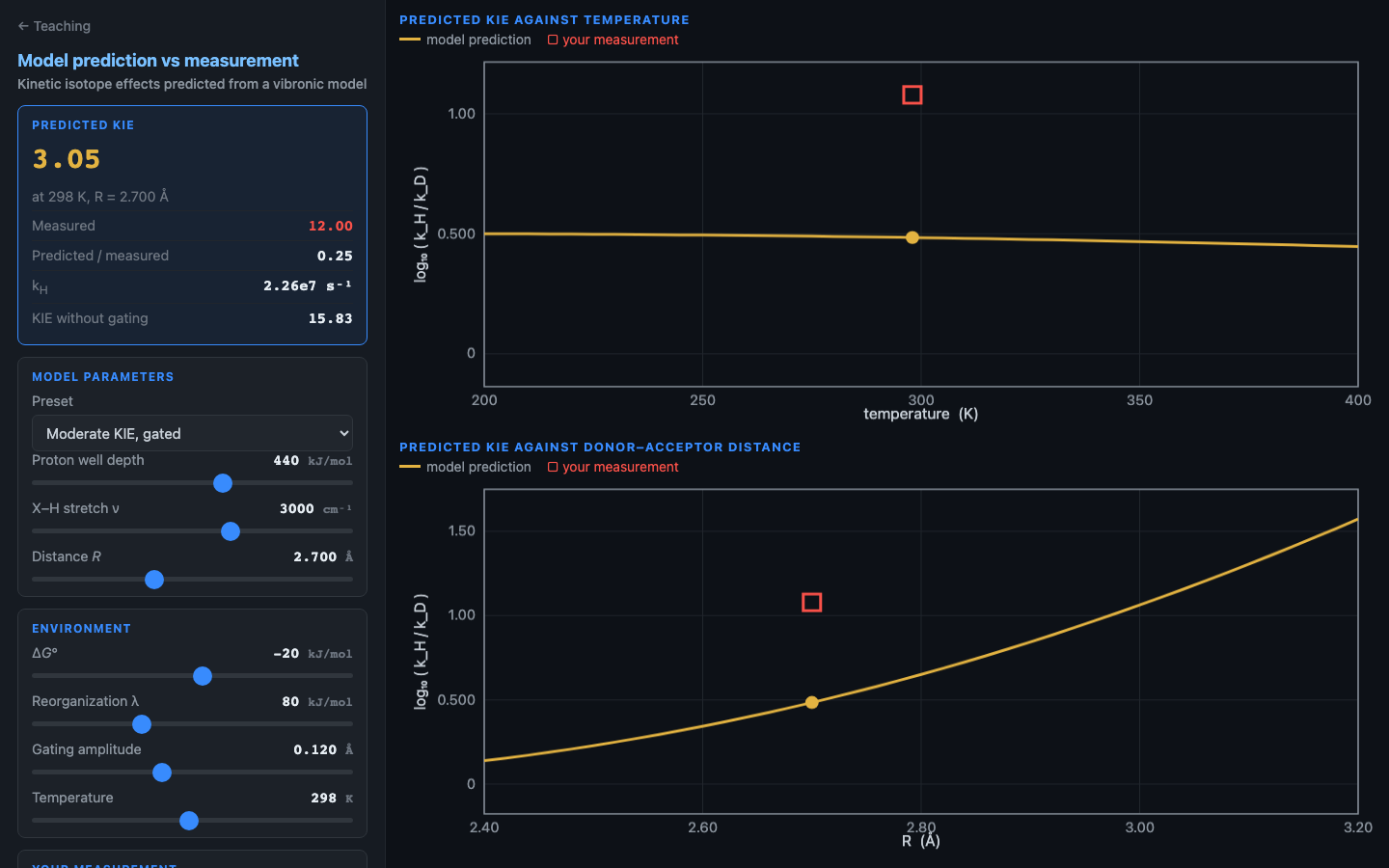
A forward model: put in barrier, frequencies, distance, ΔG° and λ, and read off the predicted kinetic isotope effect and its dependence on temperature and distance. Enter a measured value and it is overlaid for comparison. The app runs in one direction only — many parameter sets give the same KIE, so a match does not establish a mechanism.
1D quantum thermometer
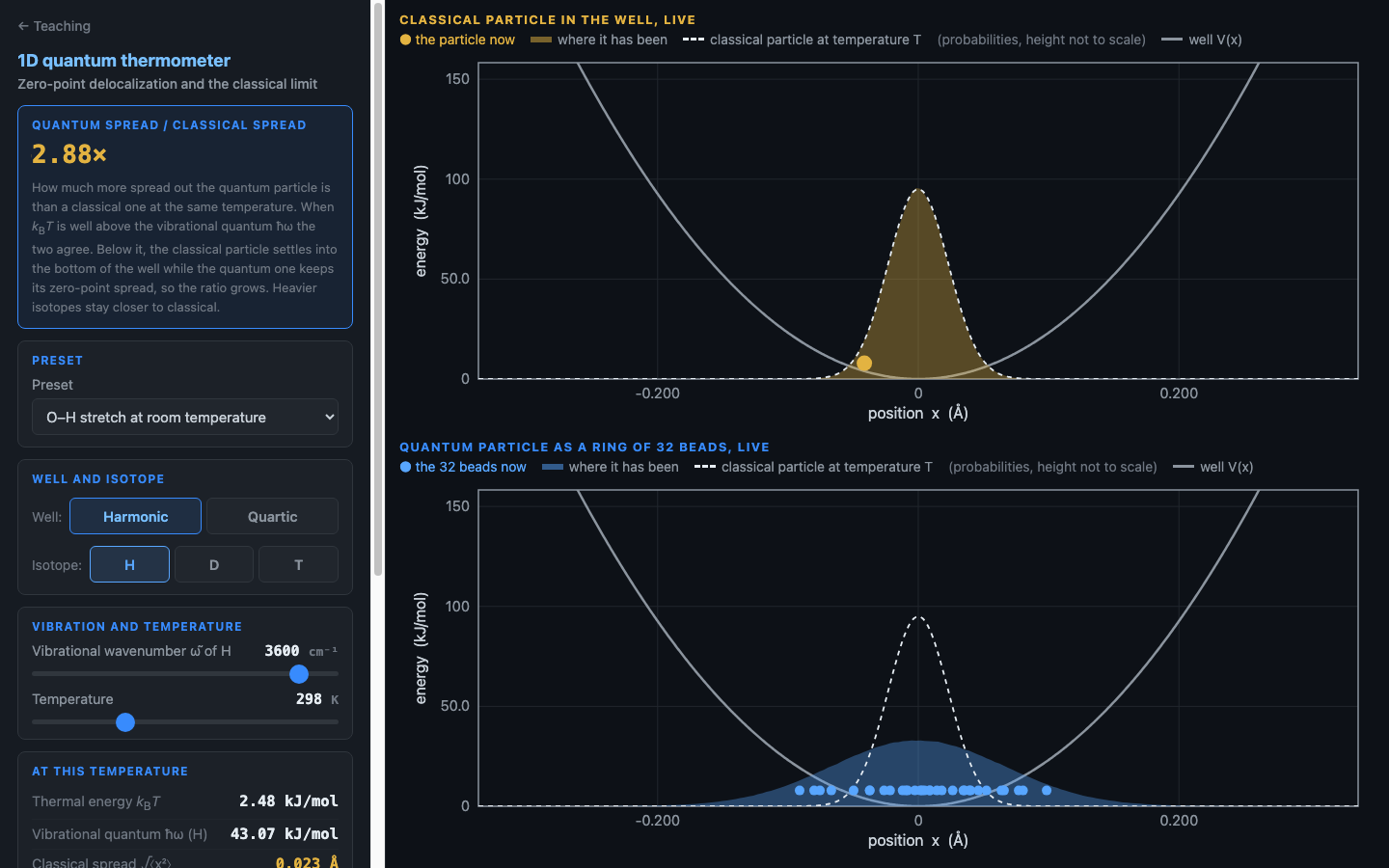
A classical particle and a quantum particle in the same well, simulated live. Set a vibrational wavenumber in cm−1 and a temperature in kelvin, and compare where each is found, in Ångström. The classical one settles into the bottom of the well as the temperature falls; the quantum one keeps its zero-point spread. An O–H stretch stays quantum even at 1000 K.
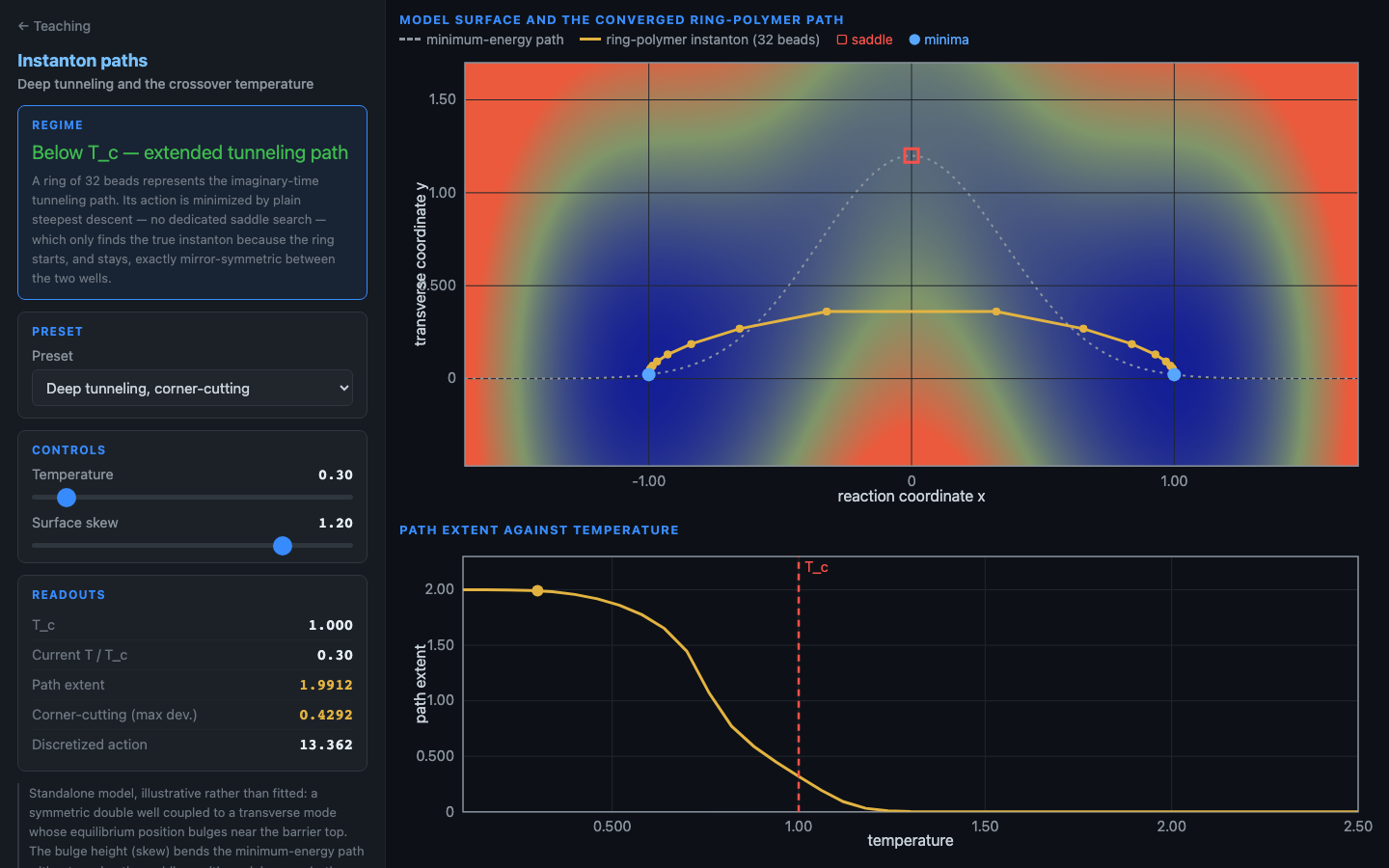
Instanton paths
A 32-bead ring polymer finds the dominant tunneling path by minimizing its action — no dedicated saddle search, just gradient descent from a path that already spans both wells. Above the crossover temperature it collapses onto the saddle; below it, an extended path survives and visibly cuts the corner of a curved valley rather than following the minimum-energy path.